
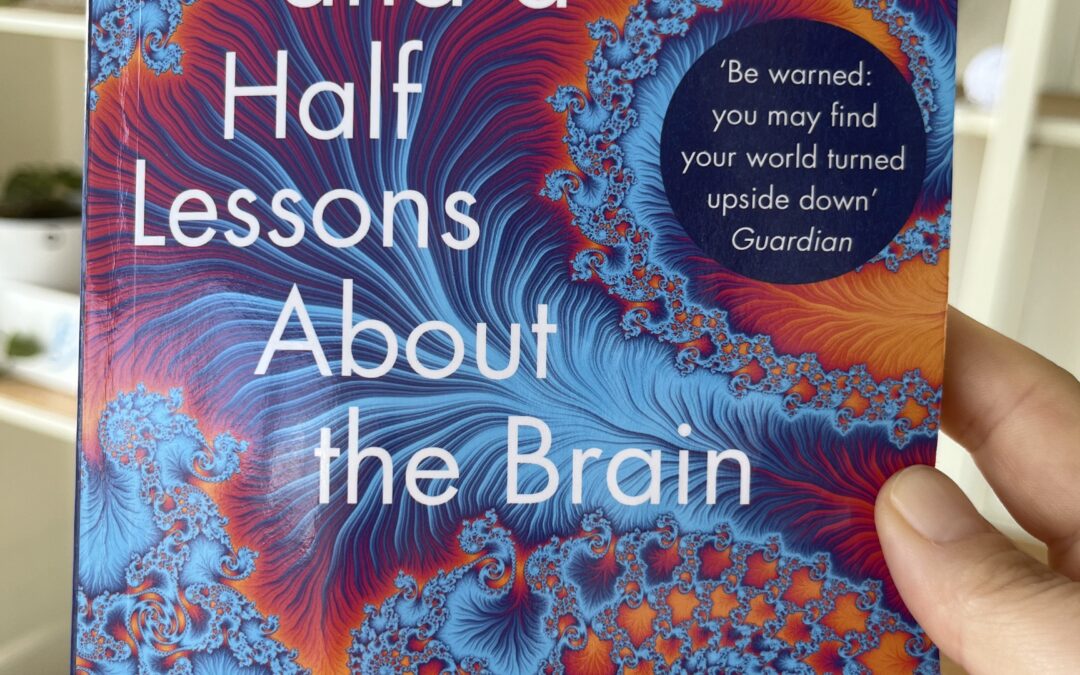
📚 The Book of January 📚
A book of January is 🧠 “Seven and a Half Lessons About the Brain” 🧠 by Lisa Feldman Barrett, Ph.D. (2020) who specializes in research in psychology and neurology.
Barrett’s style is clear and she uses such amazing and even simple metaphors that understanding the brain has never been easier at least for me. Also this book has very illustrative pictures to help understanding. I found it so fascinating and there are so many things to write about this informative yet highly readable 130 pages.
I will start with one of the lessons which is quite an opposite to the still very popular but outdated idea of a battle between instincts, emotions and rationality originating from Plato’s ideas and continued to the conclusion of research in mid-twentieth century that our brain is evolved accordingly to three different layers. It was made popular by research that was relevant back then and based mostly on visual inspection. It nicely also followed common sense and Darwin’s ideas about the evolution of human cognition. However, this is proved not to be true by the latest science and research methods in molecular genetics.
Based on the latest studies there are no so called triune brain constructed of and developed in an order of survival brain (lizard/reptile brain) for instincts, emotional brain (limbic system) inherited from prehistoric mammals and rational brain (neocortex) for human’s rationality. There is no “battle” between these three areas either. There is only one brain that is a network.
Now we know that reptiles and nonhuman mammals actually have similar types of neurons that humans do – also for neocortex. What is latest in science is that biological building blocks (genes) are the same and we also have the same “manufacturing plan” (in which order neurons are created) than all mammals and most probably reptiles too. What is different is timing how long different stages of evolving last and this is also affecting the size. So over evolutionary time our brain got bigger and reorganised and specialised to adapt to the environment humans are living. However, it did not add layers that differentiate us from other animals.
Based on the above an interesting and maybe even surprising fact is that we do not have a more developed brain than for example rats or some fish. Our brain is just developed in a different way and is much much more complex as a network. How this network functions and how instincts, emotions and thinking work is another topic. How we manage them and choose our behavior, as well. Maybe more about those later.
If you want to learn more specifically why there is one brain I highly recommend reading Lesson 1. I also warmly recommend reading the whole book and learning so much more about this around 1,3 kg organ, its development and function. 😊